
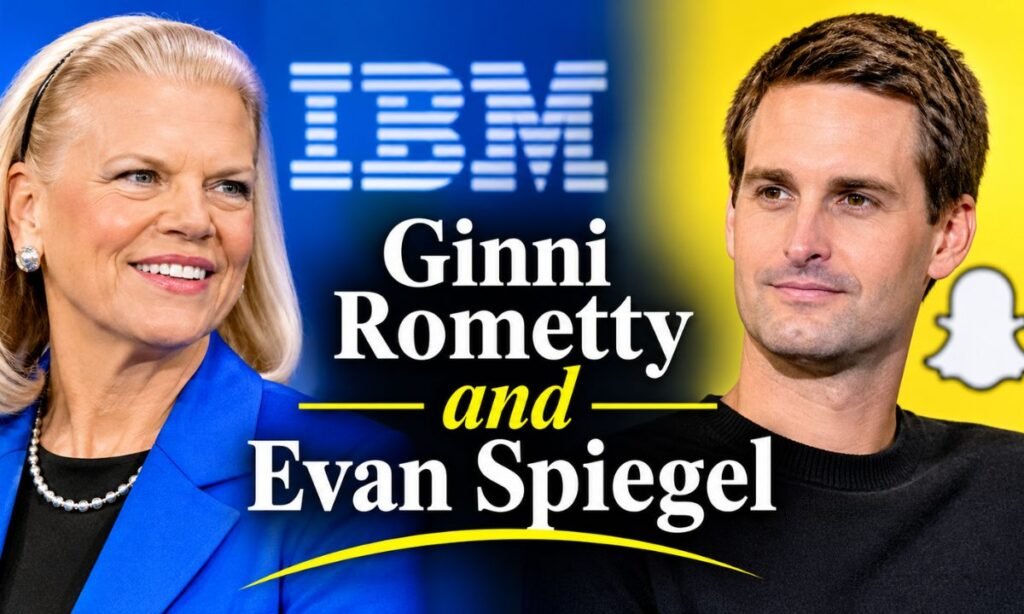
Would you rather steer a giant ship or build a speedboat? Ginni Rometty and Evan Spiegel chose different vessels. Rometty guided IBM through massive change. Spiegel built Snapchat from a Stanford idea. Their stories show two different paths to technology leadership. Both teach real lessons for founders and managers alike today.
This guide compares Ginni Rometty and Evan Spiegel across careers, strategy, and influence. You’ll see how a longtime IBM executive and a young Snap Inc. founder shaped technology industry leadership. Along the way, you’ll find tables, facts, and practical takeaways. Grab a coffee, because this story moves quickly from boardrooms to smartphones to smart glasses.
Quick Bio Table
Here’s the short version before we dive in. This quick look at Ginni Rometty vs. Evan Spiegel shows how corporate transformation and entrepreneurship and innovation shaped two careers. The table below covers all the basics.
| Detail | Ginni Rometty | Evan Spiegel |
| Full name | Virginia M. Rometty | Evan Thomas Spiegel |
| Profession | Business executive and former IBM CEO | Entrepreneur and technology executive |
| Best known for | Leading IBM from 2012 to 2020 | Co-founding Snapchat and Snap Inc. |
| Company | IBM | Snap Inc. |
| Education | Northwestern University | Stanford University |
| Main areas | Enterprise technology, AI, cloud computing | Social media, visual communication, augmented reality |
| Major milestone | IBM’s strategic transformation and Red Hat acquisition | Building Snapchat into a global social platform |
Rometty built her career inside one famous company. Spiegel started his own. That difference explains almost every choice they made. Still, both leaders had to bet on new technology and faced real doubts along the way.
Read About: Shane Gillis Sister: Meet Kait and Sarah Gillis and Their Story
Who Is Ginni Rometty?
Virginia M. Rometty, known as Ginni Rometty, is an American business executive. She served as Chairman, President, and CEO of IBM. Her career spanned nearly four decades inside one company, which gives her story unusual depth for anyone studying organizational leadership.
She became CEO in January 2012 and retired in December 2020. Her tenure overlapped with huge shifts in technology industry leadership, including cloud growth, artificial intelligence, and technology-driven business services. Few executives have navigated such rapid change at that scale.
Early Life and Education at Northwestern
Rometty earned a bachelor’s degree with high honors in computer science and electrical engineering from Northwestern University. That technical foundation set her apart later. She understood the products her teams sold, which helped her earn trust with engineers and customers alike.
Climbing the Ranks at IBM Since 1981
She joined IBM in 1981 and worked across technology, consulting, sales, and corporate strategy. Later, she held senior roles at IBM Global Services and IBM Global Business Services. Each role widened her view of customers and prepared her for corporate strategic planning.
The PwC Consulting Integration
Rometty also helped integrate PricewaterhouseCoopers Consulting into IBM. That acquisition expanded the company’s consulting capabilities. It gave her a defining proof point before the top job, because she clearly showed she could merge large and complex teams and deliver results.
Ginni Rometty’s Leadership at IBM
Rometty’s leadership at IBM centered on one big goal. She wanted to move the company toward higher-value technology services. That shift demanded new skills, new investments, and a new portfolio. It’s a textbook example of enterprise technology strategy in action.
IBM had a long history in hardware and enterprise technology. Market conditions, however, required fresh capabilities. Rometty responded with focused cloud technology investments, new services, and portfolio changes. The result reshaped how IBM competed in the technology market competition of her era.
Becoming CEO and Betting on Hybrid Cloud Computing
Hybrid cloud computing lets companies blend private infrastructure with public cloud services. Think of a building with both private and public rooms. IBM invested heavily here, along with artificial intelligence, cybersecurity, and quantum computing, as part of its hybrid cloud strategy.
The $34 Billion Red Hat Acquisition
In 2019, IBM completed its roughly $34 billion acquisition of Red Hat. Red Hat built enterprise open-source software and cloud tools. The deal strengthened IBM’s hybrid cloud plans and helped businesses run applications across different computing environments with more flexibility.
Case Study: IBM and Red Hat
- Challenge: IBM needed stronger hybrid cloud capabilities.
- Move: IBM completed the roughly $34 billion deal in 2019.
- Outcome: A bigger role in helping businesses run applications across environments.
Workforce Development and P-TECH
Rometty also championed workforce development and technology education. P-TECH blends secondary education with college-level learning and career preparation. It linked classrooms to real employer needs. Students quickly gained practical skills for changing job markets while companies also gained future talent.
Who Is Evan Spiegel?
Evan Thomas Spiegel is an American entrepreneur and co-founder and CEO of Snap Inc., the company behind Snapchat. Born on June 4, 1990, he studied product design at Stanford University. His path shows how bold student ideas can become global businesses.
Spiegel and Bobby Murphy founded the company that became Snap. Spiegel has served as CEO since May 2012. Unlike Rometty, he didn’t climb a corporate ladder. He built the ladder himself, one product at a time, while leading a fast-growing startup.
Stanford Roots and the Birth of Snapchat
At Stanford, Spiegel worked with Bobby Murphy and other collaborators on early versions of the service. That project became Snapchat. It started as a small idea but grew into a major player among digital communication platforms that changed how younger people share moments online.
Going Public in 2017
Snap Inc. became a publicly traded company in 2017. The public listing brought greater access to capital. It also raised expectations around financial performance, sustainable growth, and shareholder value, which tested public company leadership in ways a private startup never faces.
Evan Spiegel and the Growth of Snapchat
Snapchat began with a simple idea. Disappearing photo and video messages felt casual and fresh. The format stood out from networks built around permanent posts and sparked real social media innovation among young users. Simplicity won them over.
Over time, Snap added Stories, filters, and augmented reality lenses. It also built digital advertising tools for brands. Competition from larger rivals never eased. Snap had to keep proving its value to both users and advertisers.
Stories, Filters, and Digital Product Innovation
The Stories feature widened Snapchat’s audience. Camera filters made the app playful. These additions quickly pushed digital product innovation forward. Soon the camera became the center of the whole experience, which made visual communication the true heart of the brand.
Running a Public Company in Social Media
Leading Snap today means balancing product ideas with profit goals. The platform must stay relevant to users. It must also support creators and attract advertisers. That balance tests long-term business objectives for any business that depends on large online communities.
Evan Spiegel’s Interest in Augmented Reality
Augmented reality technology layers digital elements over a person’s view of the real world. Picture a lens that adds a dancing hot dog to your kitchen table. Fun, right? Snap treats this idea as more than a toy.
Snap has invested in AR through camera tools and its smart-glasses initiative. These efforts reflect Spiegel’s interest in computing beyond conventional smartphones. Success isn’t guaranteed, though. Hardware brings tough challenges that could slow the consumer technology experiences Snap hopes to create.
Specs and Smart Glasses Technology
In 2026, Snap continued advancing Specs and established Specs Inc. as a distinct subsidiary. This move shows how seriously the company takes smart glasses technology. Glasses could someday help you access information, communicate, and explore your surroundings without reaching for a phone.
The Risks Behind the Hype
Smart glasses face real hurdles. Manufacturing costs run quite high. Privacy concerns worry many shoppers. Consumers need clear everyday benefits, comfortable design, and reliable performance. Meanwhile, competition from other tech giants keeps rising. Nobody can promise a guaranteed commercial win.
Ginni Rometty and Evan Spiegel: Comparing Their Leadership Styles
Comparing Ginni Rometty and Evan Spiegel reveals two different leadership styles. Rometty managed a global corporation with decades of history, complex operations, and enterprise customers. Spiegel leads a company tied to consumer communication, which demands fast product decisions and constant attention to user behavior.
Both leaders adapted to changing markets. Rometty used acquisitions, portfolio shifts, and new capabilities. Spiegel used features, advertising products, and new platforms. These choices highlight different business growth strategies. Still, each leader had to decide which technologies deserved investment.
Steering a Giant vs. Building From Scratch
Rometty steered an established giant while protecting existing customers. Spiegel built a company from scratch around a new idea. One leader worked inside a legacy system. The other created the system. Both paths test organizational leadership and demand clear priorities.
How Each Leader Handles Risk
Corporate change risks damaging systems that already work. Entrepreneurial bets risk building products nobody wants. Rometty faced the first danger, while Spiegel faced the second. Neither path ever guarantees success. Smart leaders carefully balance immediate needs against long-term business objectives.
Comparison Table: Rometty and Spiegel Leadership Styles
| Factor | Ginni Rometty | Evan Spiegel |
| Starting point | Established global corporation | New digital product idea |
| Main tools | Acquisitions, portfolio shifts, new capabilities | Features, advertising products, new platforms |
| Biggest bet | Hybrid cloud and AI | Augmented reality and Specs |
| Key risk | Disrupting existing operations | Uncertain long-term demand |
| Defining move | Red Hat acquisition | Building Snapchat and Stories |
The Influence of Ginni Rometty and Evan Spiegel on the Technology Industry
The influence of Ginni Rometty and Evan Spiegel spans both enterprise and consumer markets. Rometty’s work strengthened IBM’s focus on hybrid cloud, AI, and security. These areas still shape how organizations manage information and modernize operations in the digital economy.
Spiegel’s contribution connects to camera-based social experiences. Snapchat helped popularize messaging formats that broke from traditional social networking. Meanwhile, Snap’s AR work explores how people may interact with digital content tomorrow. Together, their efforts show how technology leaders influence daily life.
Rometty’s Mark on Enterprise Technology
Rometty’s legacy lives in enterprise technology themes such as hybrid cloud, AI, and security. IBM’s bets on these areas continue to influence how businesses manage software. Her work also strengthened technology-driven business services, helping clients modernize without abandoning existing systems.
Spiegel’s Mark on Visual Messaging and Privacy
Spiegel’s visual messaging approach reshaped expectations for social apps. Yet modern leaders can’t ignore privacy, responsible data use, and digital well-being. As technology becomes part of everyday life, customers expect companies to weigh social consequences as carefully as they weigh growth.
Lessons From Their Professional Journeys
The careers of Ginni Rometty and Evan Spiegel offer practical lessons for aspiring entrepreneurs, managers, and technology professionals. Neither story follows a perfect script. Still, patterns emerge that you can apply to your own work, whether you lead a team or run a startup.
Rometty is widely quoted as saying, “Growth and comfort do not coexist.” That idea fits both leaders. Each stepped outside comfort zones, made bold bets, and accepted uncertainty. You can do the same even on a much smaller scale.
Keep Learning and Adapt Before the Market Forces You
Rometty built her career through decades of varied roles at IBM. Spiegel built a company around shifting patterns in digital communication. Both kept learning and adapted before their markets forced the issue. Example: IBM added cloud services, while Snap added Stories.
Focus Your Limited Resources
Every organization has limited resources. Leaders must decide which markets and customer needs deserve priority. IBM focused on hybrid cloud and AI. Snap focused on camera-first products and AR. Your example might be a bakery choosing one signature product before adding a dozen menu items.
Frequently Asked Questions
Who is Ginni Rometty?
Ginni Rometty, whose full name is Virginia M. Rometty, is a former Chairman, President, and CEO of IBM. She joined the company in 1981, became CEO in January 2012, and retired in December 2020 after leading its push into hybrid cloud and AI.
What is Evan Spiegel best known for?
Evan Spiegel is best known for co-founding Snapchat and serving as CEO of Snap Inc. since May 2012. Born on June 4, 1990, he studied product design at Stanford University and helped turn disappearing messages into a global communication brand.
What was the Red Hat deal?
IBM completed its roughly $34 billion acquisition of Red Hat in 2019. Red Hat is known for enterprise open-source software and cloud technologies. The deal strengthened IBM’s hybrid cloud strategy and expanded its role in helping companies run applications across environments.
What are Snap Specs?
Specs is Snap’s smart-glasses initiative. In 2026, the company established Specs Inc. as a distinct subsidiary. The glasses aim to bring computing beyond smartphones, though manufacturing costs, privacy concerns, consumer adoption, and competition could all affect their long-term commercial success.
Who had the harder path, Rometty or Spiegel?
Neither path was easy. Rometty worked to transform a large global corporation while keeping existing customers. Spiegel built a startup into a public company despite intense competition from larger rivals. Each path carried very different risks. Neither path guarantees success.
Final Thoughts
Ginni Rometty and Evan Spiegel show two paths to technology leadership. One guided an established giant through corporate transformation. The other built a consumer platform from a Stanford idea. Both adapted, invested, and planned for the long term.
So which path fits you? Whether you want to reshape a big organization or launch something completely new, their stories offer genuinely useful guidance. Share your thoughts in the comments and subscribe for more leadership breakdowns like this.

Through poetry, Zain Seo gives words to feelings that are often difficult to express. As the author behind Poetry Linez, Zain Seo writes about love, heartbreak, life, emotions, hope, and the stories within every heart.
