
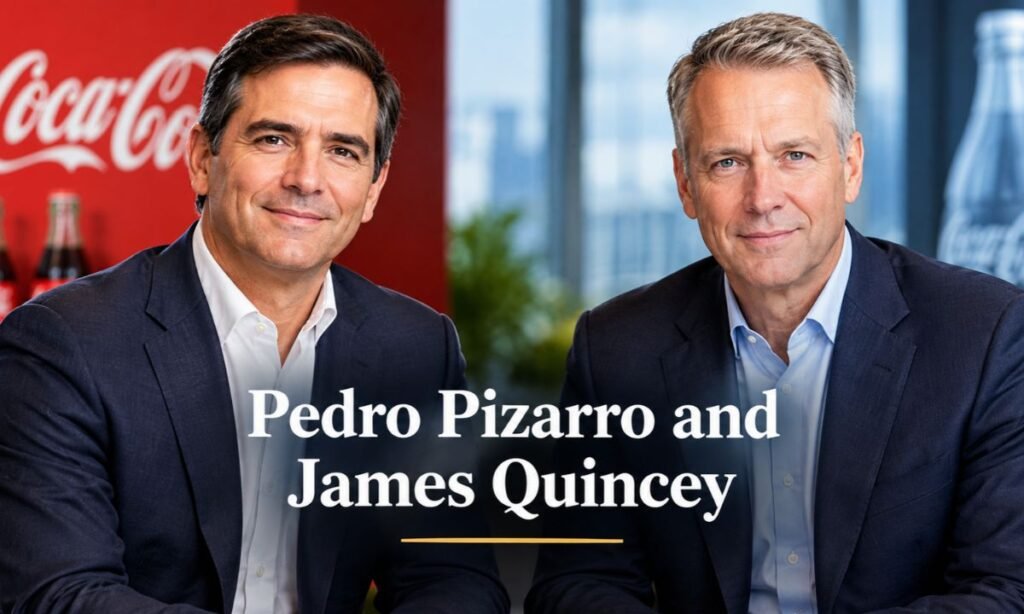
Picture a cold Coke on a hot afternoon. Now picture flipping a light switch in a dark room. Pedro Pizarro and James Quincey help power both moments. This guide covers their net worth and business success. You’ll see how The Coca-Cola Company and Edison International differ. Their paths cross in surprising ways.
One big update matters right away. Henrique Braun became Coca-Cola CEO on March 31, 2026. James Quincey stayed on as executive chairman. That CEO succession kept the company steady. Meanwhile, Pizarro still serves as president and CEO at Edison. Both lead huge systems under constant public scrutiny. Stick around for salary data, strategy, and practical lessons.
Pedro Pizarro and James Quincey at a Glance
Need the short version of this story? Here’s a quick snapshot of Pedro Pizarro and James Quincey. One leads Edison International as president and CEO. The other is now executive chairman at Coca-Cola. The table below shows the key facts.
Treat the net worth estimates below as rough guides. Neither leader publishes a personal balance sheet. Public filings and market data fill the gaps. For example, annual compensation comes straight from proxy statements. Stock prices can shift those numbers overnight.
| Detail | James Quincey | Pedro Pizarro |
| Role in 2026 | Executive chairman, Coca-Cola | President and CEO, Edison International |
| CEO tenure | May 2017 to March 31, 2026 | Since 2016 |
| Joined company | 1996 | 1999 |
| Latest disclosed pay | About $28.0 million (2024) | About $16.6 million (2025) |
| Estimated net worth | About $70 million | About $25 million |
Read About: Dave Calhoun and María Asunción Aramburuzabala: Two Business Leaders Compared Side by Side
James Quincey: Leading a Global Consumer Brand
James Quincey and Pedro Pizarro lead very different giants. Few jobs carry a bigger spotlight than running Coca-Cola. The brand sells in more than 200 countries and territories. That reach demands steady business leadership every day.
Quincey shaped corporate strategy for famous consumer brands. His career achievements span marketing, operations, and big deals. Moreover, his corporate leadership style favors patience over drama. Let’s walk through his story one step at a time.
James Quincey Biography: From Career Insider to CEO
The James Quincey biography begins in 1996 at Coca-Cola. He became chief operating officer in 2015. He took over as CEO in 2017. The board added the chairman title in 2019. He handed the CEO job to Henrique Braun in 2026.
The “Total Beverage Company” Strategy
The total beverage company vision changed everything. Picture a restaurant that grew from one burger. Costa Coffee, BodyArmor, and fairlife all fit that plan. Coca-Cola Zero Sugar fueled growth in the beverage industry. The company added more than 10 billion-dollar brands.
Case Study: Cutting the Brand List to Grow Faster
In 2020, Coca-Cola planned to cut roughly half its brands. Tab diet soda was among them. Hundreds of small names drained cash and attention. This brand portfolio strategy favored fewer, bigger bets. The takeaway applies to any business. Smart growth sometimes comes from subtraction.
Pedro Pizarro and James Quincey Net Worth: The Coke Side
James Quincey net worth estimates sit near $70 million. James Quincey salary data shows $28.0 million in 2024. Annual compensation was $24.7 million in 2023. Most of it arrived as stock awards and stock options. Insider data showed about 395,237 shares in early 2025.
The 2026 Handoff
Henrique Braun became CEO on March 31, 2026. He’s 57 and joined Coca-Cola in 1996. Quincey now serves as executive chairman. Insiders call this a planned internal CEO succession. Investors usually welcome that kind of move. It signals continuity and keeps customers calm.
Coca-Cola’s Financial Scorecard Under Quincey
Financial performance stayed strong in 2025. Net revenues reached $47.9 billion last year. Revenue growth hit 2% reported and 5% organic. Comparable operating margin landed at 31.2%. Earnings per share came in at $3.04. Free cash flow hit $5.3 billion after a fairlife payment.
Digital Transformation and Business Adaptation
A 130-year-old company can’t survive on nostalgia. Digital transformation gave Coca-Cola new tools and fresh habits. Quincey pushed teams to adapt quickly. That business adaptation paid off during the toughest years. Technology now touches sales, marketing, and supply.
This business transformation didn’t happen overnight. Several moves stand out for U.S. readers. They include smart dispensers, limited editions, and online delivery. Each move helped the company learn from consumer behavior. Data guided what shipped and where.
Steering Through the Pandemic
Restaurants and theaters closed in 2020 and sales dropped. Imagine your busiest channel switching off overnight. Quincey’s team shifted toward home, e-commerce, and cheaper packs. This pandemic recovery showed real resilience. The company bounced back stronger than expected. That kind of crisis management matters.
Data, Dispensers, and AI Marketing
Coca-Cola Freestyle machines let people mix hundreds of flavors. They also collect useful taste data. Coca-Cola Creations launches short-run flavors that spark social buzz. A 2023 campaign let fans make art with AI. That artificial intelligence marketing push drew big attention.
Case Study: Learning From a Mixed Reaction
A late 2024 holiday ad used AI and drew complaints. Fans criticized its look and feel. Yet it also sparked huge conversation. Marketers can learn something practical here. New technology opens doors for any brand. Still, audiences judge craft first and novelty second.
Sustainability in the Beverage Industry
Few topics follow Coca-Cola more closely than plastic. Millions of bottles and cans leave its system yearly. Critics want to know where they end up. Sustainability now shapes costs, regulation, and reputation. Packaging waste stays front and center.
Coke launched its World Without Waste program in 2018. Those early targets were bold and public. In late 2024, the company reset many of them. Environmental groups pushed back quite hard. Leaders pointed to cost, quality, and weak collection systems.
The Packaging Goals Reset
The recycled packaging goal once said 50% by 2030. Now it targets 35% to 40% by 2035. Collection targets now aim for 70% to 75%. Refillable packaging lost its numeric target. Climate goals now follow a 1.5°C path by 2035.
Where Coke Held Firm
Not every target softened in the reset. Coke kept its promise to return more water. Water replenishment now covers more than 100% of product water. Work will expand to 200 high-risk locations by 2035. Water sits at the heart of every beverage.
Why It Matters
Packaging, water, and farm ingredients drive Coke’s costs. They also shape its public reputation and trust. A leader who dodges tough questions risks customers and regulators. Corporate sustainability isn’t a side project. It belongs inside risk management and long-term growth strategy.
Pedro Pizarro: Guiding an Energy Transformation
Switch from soda to electrons and the pressures change. Edison International delivers power through Southern California Edison. That utility serves millions across a huge slice of California. Reliability, safety, and price matter more than any flavor launch.
Pedro Pizarro leads this electric utility as president and CEO. He drives an energy transformation touching homes and businesses. The energy industry moves slower than consumer markets. However, the stakes feel just as high. Every outage lands in someone’s living room.
Pedro Pizarro Biography: Scientist Turned Utility Chief
The Pedro Pizarro biography starts with science. He holds a Harvard chemistry degree and a Caltech Ph.D. He joined Edison in 1999 and led SCE by 2014. He’s led Edison International since 2016. His career achievements reflect an engineer’s mindset.
Pedro Pizarro and James Quincey Net Worth: The Edison Side
Pedro Pizarro net worth estimates sit near $25 million. The Pedro Pizarro salary package reached $16.6 million in 2025. That equals about 75 times the median employee’s pay. His wealth rests mostly on about 321,885 Edison shares. Stock ties both fortunes to shareholder value.
Edison’s Financial Snapshot
Edison International earnings in 2025 reached $6.55 per share. That topped the high end of guidance. The company targets 5% to 7% yearly core EPS growth. Q1 2026 core earnings hit $1.42 per share. Capital investment in safety tops $12 billion over two years.
Modernizing the Electric Grid
Picture the grid as a highway from decades ago. Now add heat waves, wildfires, electric cars, and data centers. Those roads need wider lanes and stronger guardrails. Electric grid modernization delivers that upgrade. It also supports grid resilience during extreme weather.
Pizarro treats this challenge like an engineering puzzle. His team balances safety, speed, and cost. Customers expect reliable power every single day. Meanwhile, regulators review every major dollar. Energy infrastructure projects take years to finish.
Hardening Against Wildfire
Wildfire safety defines California utility work. SCE uses covered conductor, undergrounding, cameras, and power shutoffs. It also grounds idle lines every two miles. Grid hardening now covers nearly 90% of risky distribution lines. That adds up to over 14,000 miles.
Case Study: The Eaton Fire Response
The Eaton Fire began January 7, 2025 near Altadena. Investigations continue and SCE hasn’t formally concluded a cause. The Wildfire Recovery Compensation Program drew over 2,300 claims. Edison recorded $1.1 billion in related losses. Total wildfire liability remains truly uncertain today.
Permitting: The Hidden Bottleneck
In May 2026, Pizarro named permitting his biggest hurdle. Imagine ordering a highway lane and waiting a decade. Power lines face that same wait. Permitting reform could speed clean energy and safer grids. Faster reviews would put steel in the ground sooner.
Clean Energy and Electrification
California targets 100% clean energy by 2045. Edison built its long-term story around a simple idea. Clean the supply first and then electrify daily life. That means cars, buses, and home heating. Renewable energy grows alongside that rising demand.
This energy transformation reshapes daily life across California. Cities gain cleaner air and lower fuel emissions. Utilities must build bigger grids to keep pace. Meanwhile, homeowners face real upfront costs. Electric vehicles and heat pumps lead the shift.
What Electrification Means for You
Here’s a quick example for your household. A family trades a gas car and furnace for electric. Their household electricity use climbs quickly. Multiply that by millions of homes. The grid must grow much larger. Electricity demand rises while air quality improves.
The Data Center Wave
Artificial intelligence brings a newer pressure. Data centers consume huge amounts of power. Utilities now plan for growth after years of flat demand. That growth can fund new grid investment. However, it can lift rates if costs aren’t shared fairly.
Affordability
Pizarro stresses cost control at every turn. SCE wants the lowest average rate among California’s large utilities. It announced a 2.3% residential rate cut. Small businesses saw a 5.3% cut. Customer affordability and utility rates shape safety decisions.
Two Industries, Similar Leadership Challenges for Pedro Pizarro and James Quincey
At first glance, soda and power seem worlds apart. Dig deeper and the overlap appears. Both leaders manage complex systems under constant scrutiny. This Pedro Pizarro and James Quincey comparison reveals common ground. Public trust drives both companies’ daily decisions.
Customers, regulators, and investors all watch closely. Corporate accountability matters when mistakes become headlines fast. Each firm also plans for decades ahead. Bottling plants and power lines both last decades. Investor relations teams stay busy explaining all of it.
Side-by-Side Comparison
The table below compares both companies directly. Coke sells through retailers to billions of consumers. Edison serves millions of homes and businesses. Coke sets prices in a competitive market. State regulators approve Edison’s rates and returns. Their time horizons differ quite a bit.
| Factor | Coca-Cola | Edison International |
| Customers | Billions through retailers | Millions of homes and businesses |
| Pricing | Company and market | State regulators |
| Competition | Intense and global | Limited but regulated |
| Public pressure | Plastic, sugar, water | Wildfire safety, rates |
| Growth route | New brands and markets | Grid investment and load growth |
Shared Challenges
Both leaders face five common tests. Public trust comes first for both. Climate goals touch both packaging and power. Capital planning stretches across many decades. Regulation shapes what each firm can do. Finally, leadership succession planning keeps big organizations steady.
A Key Difference
Quincey could grow through new products and brand deals. Pizarro can’t grow that way as a utility. A regulated utility earns returns through approved grid investment. So regulatory strategy matters more for Pizarro. Patience and careful filings reward Pizarro instead.
Leadership Through Change
Both executives led through shocks that would test anyone. Their business leadership styles look quite different. Quincey reshaped a famous global menu. Pizarro now defends a stressed grid. Each path demands calm decisions under heavy pressure.
Strong corporate leadership shows up in small habits. Leaders plan early and speak plainly. They also invest before storms arrive. The next sections break down each style. Then you’ll get lessons you can borrow today.
Quincey’s Style: Reinvent and Hand Off
Quincey widened the menu and trimmed his weakest brands. He also tested new technology in public. He invested in the next group of leaders. Leaders who plan beyond their tenure protect shareholder value. That’s textbook leadership succession planning in action.
Pizarro’s Style: Engineer the Problem
Pizarro treats crises like a scientist. He leans on data, investigations, and measurable safety steps. He also speaks plainly about uncertainty. In Q1 2026, he cited no other ignition evidence. That candor supports corporate accountability during a crisis. Admitting likely responsibility takes real nerve.
Leadership Lessons You Can Use
Five lessons stand out for any team. Plan succession early like Quincey did. Prune priorities so the best ideas get room. Own hard truths during a crisis. Invest before the next storm arrives. Match goals to what your systems deliver.
Case Study: Two Ways to Handle Criticism
Both leaders drew fire in recent years. Coke faced backlash over softer packaging goals. Edison faced anger over executive compensation after the Eaton Fire. Edison pointed to safety investments and its compensation program. Critics notice gaps between promises and results.
The Future of Their Industries
The next few years look busy for both sectors. Technology, policy, and shifting habits will push change. Smart leaders track each trend closely. A long-term growth strategy will separate winners from laggards. Pedro Pizarro and James Quincey will watch it all.
Beverages face health rules and softer volume. Energy faces wildfire policy and rising demand. Both industries still depend on public confidence. Risk management will guide every big decision. Investors will judge results one quarter at a time.
What Comes Next for Beverages
Expect more Coca-Cola Zero Sugar and functional drinks under Braun. Premium coffee and dairy give Coke room to grow. Emerging markets in Asia, Africa, and Latin America stay key. Risks include soft volume and currency swings. Health rules and sugar taxes may shift demand.
What Comes Next for Energy
Wildfire policy, grid buildout, and rate pressure top the list. Electric vehicles, heat pumps, and data centers will lift demand. Permitting reform could unlock stalled projects. Edison’s stock traded near $80 before the January 2025 fires. By mid-2026, it sat in the low $70s.
What to Watch in Late 2026 and 2027
Several storylines will shape the next year. Coke’s first full year under Braun tests the handoff. Eaton Fire results could change Edison’s cost outlook. California wildfire legislation will shape utility risk and bills. The table below lists six items to track.
| Watch item | Why it matters |
| Coke’s first full year under Braun | Tests the smooth handoff |
| Quincey’s chairman role | Shows how a former CEO guides |
| Eaton Fire investigation | Could change Edison’s cost outlook |
| California wildfire legislation | Shapes utility risk and bills |
| Edison’s new CFO era | Affects financial messaging |
| Packaging collection progress | Measures Coke’s 2035 goals |
Frequently Asked Questions
Who is James Quincey?
James Quincey joined Coca-Cola in 1996 and rose steadily. He served as CEO from May 2017 to March 2026. He has also chaired the board since 2019. Today he serves as executive chairman. He drove the push toward a total beverage company.
Who is Pedro Pizarro?
Pedro Pizarro is president and CEO of Edison International. He holds chemistry degrees from Harvard and Caltech. He started at McKinsey before moving into energy. He joined Edison in 1999 and became CEO in 2016. Today he steers the company through wildfire challenges.
What company does James Quincey lead?
Quincey no longer runs daily operations at Coca-Cola. Henrique Braun became CEO on March 31, 2026. Quincey now leads the board as executive chairman. The Coca-Cola Company remains his main focus today. He guides direction without managing the daily work.
What company does Pedro Pizarro lead?
Pizarro leads Edison International as president and CEO. Its main subsidiary is Southern California Edison. SCE delivers electricity to millions of customers. The service area covers a huge slice of Southern California. Reliability and safety guide its daily work closely.
What are James Quincey’s main leadership areas?
His main areas include brand portfolio strategy and acquisitions. He also led digital marketing and pandemic recovery. Succession planning remained a steady priority too. In addition, he oversaw goals for packaging, water, and climate. These areas defined his nine years as CEO.
What are Pedro Pizarro’s main areas of focus?
Pizarro focuses on wildfire safety, grid hardening, and electrification. He also prioritizes customer affordability and lower bills. Regulatory strategy plays a central role too. He speaks often about permitting reform for new projects. Those priorities define his long tenure at Edison.
How are James Quincey and Pedro Pizarro similar?
Both are long-serving company insiders who rose through the ranks. Both lead organizations under heavy public scrutiny. Both earn most of their pay through stock. They also manage large, capital-heavy systems. Each leader plans for decades ahead. These parallels make the comparison useful.
How are their industries different?
Coca-Cola competes in a global consumer market. The company sets its own prices. Edison operates as a regulated electric utility. State regulators approve its rates and returns. Coke grows through new products and brands. Edison grows through steady grid investment.
Why do sustainability issues matter to both leaders?
For Coke, packaging waste and emissions shape brand trust. Water use affects its costs and communities too. For Edison, wildfire risk and grid resilience shape safety. Clean energy goals influence regulation as well. Both companies need public confidence to keep operating.
Final Thoughts
Two leaders run two very different companies. James Quincey guided Coca-Cola through nine years of reinvention. His estimated net worth sits near $70 million. Pedro Pizarro leads Edison through a tough stretch. His estimated wealth sits near $25 million.
The big picture feels pretty simple. Quincey showed how to keep a brand fresh. Pizarro shows how to keep the lights on. Students of Pedro Pizarro and James Quincey gain practical lessons. Follow earnings reports and proxy filings to stay current.

Through poetry, Zain Seo gives words to feelings that are often difficult to express. As the author behind Poetry Linez, Zain Seo writes about love, heartbreak, life, emotions, hope, and the stories within every heart.

1 thought on “Pedro Pizarro and James Quincey: Biography, Net Worth & Business Success in 2026”