
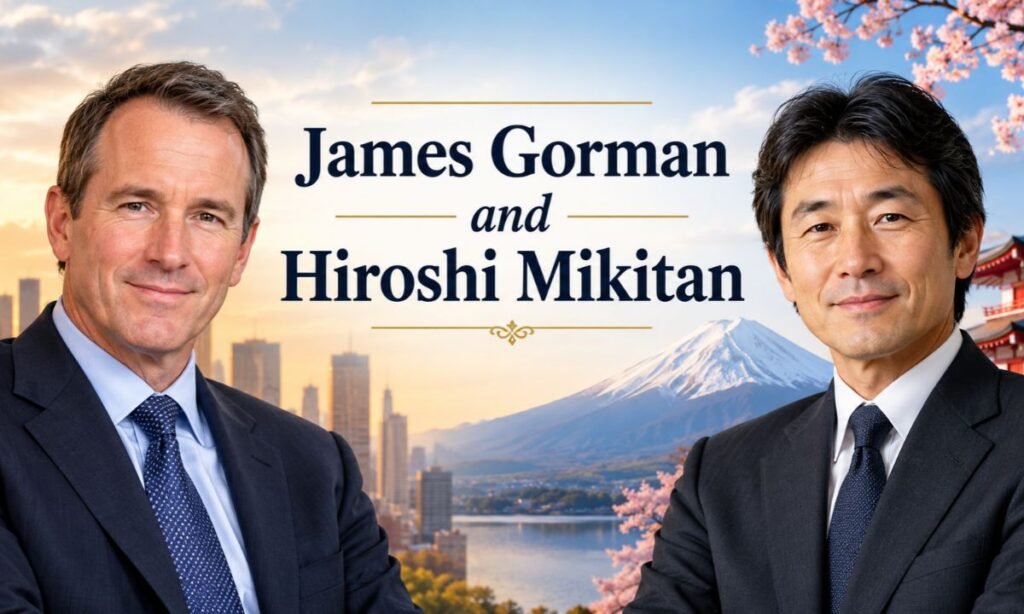
Did a secret deal link James Gorman and Hiroshi Mikitani? Many US readers search for that answer every day. The truth is simpler. These two global corporate leadership figures never built a shared company. Still, their stories sit side by side for good reason. This simple guide explains exactly why.
You will meet a banker who reshaped Morgan Stanley and now chairs The Walt Disney Company. You will also meet a hands-on founder who built Rakuten Group from scratch. Along the way, you will see tables, real numbers, and plain lessons about leadership. Read on to separate fact from rumor about James Gorman and Hiroshi Mikitani.
Who Are James Gorman and Hiroshi Mikitani?
James Gorman is an Australian-born banker. He led Morgan Stanley from 2010 to 2023 and now chairs Disney’s board. His path ran through law, consulting, and banking. Few executives move from the corner office to the boardroom so smoothly.
Hiroshi Mikitani took the founder route. He founded Rakuten Group in 1997 and still runs it today. He holds the titles of chairman, president, and CEO. That makes him a hands-on operator rather than a hired leader.
| Area | James Gorman | Hiroshi Mikitani |
| Best known for | Former CEO, Morgan Stanley | Founder, Rakuten Group |
| Current role | Chairman, The Walt Disney Company | Chairman, President, and CEO, Rakuten |
| Career start | Law, consulting, banking | Banking, entrepreneurship |
| Education | University of Melbourne, Columbia Business School | Hitotsubashi University, Harvard Business School |
| Leadership style | Professional executive leadership | Founder-led management |
Read About: David Lawler and Bruce Broussard Careers, Leadership, and Achievements
What Is the Connection Between James Gorman and Hiroshi Mikitani?
Here is the plain truth. No confirmed partnership, joint company, or shared board seat links these two men. Their bond is reputational. Both hold profiles with the World Economic Forum and both command respect across multinational corporations worldwide.
That overlap fuels search curiosity. Readers want a comparison, not a hidden deal. So the James Gorman Hiroshi Mikitani connection works best as a leadership study. It shows two quite different paths to corporate governance success.
Fact check:
- No verified joint venture or shared company
- No shared corporate board seat
- Both hold World Economic Forum profiles
- Best understood as a Gorman and Mikitani relationship of contrast, not partnership
James Gorman’s Career and Morgan Stanley Transformation
Gorman trained as a lawyer in Melbourne. He then moved to McKinsey & Company and later Merrill Lynch. In 2006 he joined Morgan Stanley. He became CEO in January 2010 as the bank rebuilt after the financial crisis.
His corporate strategy favored steadier income. Instead of leaning on volatile trading, he pushed the bank toward wealth management and investment management. That shift reshaped the business mix for the long run and gave Morgan Stanley more recurring revenue.
Expansion of Wealth Management
The 2020 E*TRADE deal added over 5.2 million client accounts and $360 billion in retail assets. Paired with the Eaton Vance purchase, it lifted fee-based income and built roughly $3.3 trillion in wealth management operations across the entire firm today.
Case study: two deals, one new identity
- E*TRADE: brought millions of everyday American investors into the fold
- Eaton Vance: added an investment manager that boosted fee-based advisory income
Gorman’s Succession at Morgan Stanley
Ted Pick became CEO on January 1, 2024. Gorman stayed on as executive chairman. By January 2025, Pick also took the chairman title. Gorman became chairman emeritus, which closed an orderly chapter and offered a clean model of executive succession planning.
James Gorman’s Role at Disney
Gorman’s next chapter unfolded at The Walt Disney Company. He first chaired the Succession Planning Committee. He became board chairman on January 2, 2025. His job centers on corporate governance and oversight rather than daily operations.
That committee work led somewhere concrete. Disney named Josh D’Amaro as CEO to succeed Bob Iger, effective at the March 2026 annual meeting. Today the James Gorman Disney chairman role means he leads the board and guides strategy. Think of him as the coach, not the quarterback.
Who Is Hiroshi Mikitani?
Born in Kobe, Mikitani studied at Hitotsubashi University. He then joined the Industrial Bank of Japan. In 1993 he earned an MBA from Harvard Business School. That mix of banking and business training shaped his entrepreneurial instincts.
He launched what became Rakuten in February 1997. Unlike Gorman, he never climbed an existing ladder. He built his own. Rakuten now calls itself an ecosystem of over 70 businesses reaching about 2.1 billion people worldwide. It reflects founder-led management in action.
How Mikitani Built the Rakuten Ecosystem
Think of it as a mall where every store shares one loyalty card. Rakuten’s digital business ecosystem spans e-commerce marketplace services, financial technology, digital content, and a telecommunications business. Each piece keeps customers inside the family.
The logic is customer lifetime value. A shopper might use the marketplace, collect Rakuten Points, open a bank account, and subscribe to Rakuten Mobile. Each step deepens loyalty and lowers customer acquisition costs across the group.
| Segment | Example |
| E-commerce | Online marketplace |
| Financial technology | Rakuten Bank, securities, credit cards |
| Communications | Rakuten Mobile, telecommunications |
| Loyalty | Rakuten Points, loyalty programs |
Rakuten’s Current Financial Position
Rakuten posted 2025 revenue of ¥2.497 trillion, up 9.5% year over year. IFRS operating income reached ¥14.4 billion. That signals solid growth across its sprawling digital businesses. Profit, however, remains thin compared with the sales volume.
Rakuten Mobile hit a milestone with its first full-year EBITDA profit. Subscriptions neared 10.01 million by December 2025. Still, it posted a non-GAAP operating loss. Progress is real yet the mobile business has not fully healed.
Key numbers:
- Revenue: ¥2.497 trillion (up 9.5%)
- IFRS operating income: ¥14.4 billion
- Mobile subscriptions: about 10.01 million
Mikitani’s Ownership Position
Founders play with their own chips. A February 2026 disclosure listed Mikitani with about 8.14% of Rakuten shares. That stake gives him real founder ownership alongside his executive title. Few hired executives enjoy that kind of skin in the game.
Crimson Group, LLC, tied to his business interests, separately held 10.43%. Gorman, by contrast, never owned Morgan Stanley. That gap shows how ownership shapes influence and control over long-term business growth decisions across the company.
James Gorman and Hiroshi Mikitani: Two Leadership Models
Same industry neighborhood, totally different playbooks. Gorman reshaped an inherited financial institution through acquisitions and disciplined succession. Mikitani built something from nothing and stayed attached to every stage of growth. Neither approach is better. They answer different needs.
Each model fits a different company stage. A mature institution needs stability. A fast-moving venture needs vision and reinvention. This Gorman vs. Mikitani leadership contrast helps you quickly see which style suits which kind of challenge.
Gorman: Institutional Transformation
Gorman did not found Morgan Stanley. He reshaped it piece by piece. Through E*TRADE and Eaton Vance, he shifted revenue toward recurring revenue. At Disney, he guides strategy without running daily operations. That pattern defines institutional transformation in practice today.
Mikitani: Founder-Led Expansion
Mikitani still owns and operates Rakuten nearly three decades later. He keeps adding businesses, most notably Rakuten Mobile. That bet tests how far founder-led management can stretch across infrastructure, finance, and content. Control brings speed. It also brings real risk.
What They Have in Common
Opposites still share a few traits. Both started in finance-adjacent roles. Gorman worked in consulting and banking. Mikitani began at the Industrial Bank of Japan. Those early years gave each man a sharp feel for money and markets.
Both also pursued international business expansion. Each studied or worked abroad before leading multinational corporations. Both remain fixtures at global forums too. The World Economic Forum lists profiles for each, which cements their place in global corporate leadership circles.
- Finance-rooted early careers
- A track record of international growth
- Recognized names in global business forums
Major Differences Between Gorman and Mikitani
One was recruited. The other started from zero. Gorman rose through hiring and promotion before reshaping a giant bank. Mikitani assembled new businesses around one he created himself. Their paths could hardly look more different.
Authority differs sharply too. Gorman’s Morgan Stanley title is honorary and his Disney seat sits at board level. Mikitani holds full operating authority as Rakuten’s chairman, president, and CEO. This reflects professional executive leadership versus founder control.
| Factor | James Gorman | Hiroshi Mikitani |
| Founded the company? | No | Yes |
| Current authority | Disney board chairman | Rakuten President and CEO |
| Ownership stake | No founder stake | About 8.14% personal stake |
| Career pattern | Orderly succession and exit | Continuous founder-led expansion |
Why the James Gorman and Hiroshi Mikitani Comparison Matters
Business students could study this pair for years. The comparison shows two valid routes to lasting institutions. One relies on professional discipline and sound corporate governance. The other relies on founder vision sustained over decades.
Neither model guarantees success alone. Capital needs, governance demands, and company maturity should decide the structure. American investors, managers, and entrepreneurs can borrow from both playbooks. Pick the style that matches your corporate strategy and your stage of growth.
Key takeaway: Structure should follow the company’s needs, not personal preference.
What you can learn:
- Plan succession early and calmly
- Build recurring revenue to steady your business
- Use ownership to support long-term thinking
Frequently Asked Questions
Are James Gorman and Hiroshi Mikitani connected professionally?
No public record shows a business partnership, joint venture, or shared board seat. Their link is reputational. Both appear among respected international executives and both hold World Economic Forum profiles. That is why a comparison fits better than a deal story.
What companies are James Gorman and Hiroshi Mikitani associated with?
Gorman led Morgan Stanley and now chairs The Walt Disney Company. Mikitani founded Rakuten Group and still runs it. One leader reshaped a Wall Street bank. The other built a sprawling Japanese digital ecosystem from a startup.
What is James Gorman known for today?
Gorman is known for leading Morgan Stanley from 2010 to 2023. He pushed the bank into wealth management through E*TRADE and Eaton Vance. Today he serves as Disney’s board chairman and guides governance and long-term strategy.
What is Hiroshi Mikitani known for?
Mikitani is known for founding Rakuten in 1997 and building it into a global ecosystem. He still serves as chairman, president, and CEO. His banking background and Harvard MBA shaped a bold, founder-led approach to growth.
Why do James Gorman and Hiroshi Mikitani appear in the same searches?
People pair them because both are prominent executives with international influence. Each also holds a World Economic Forum profile. Searchers often expect a hidden deal. In reality, the pairing reflects shared reputation rather than a shared company.
Do Gorman and Mikitani have similar leadership backgrounds?
Only partly. Both began in finance-adjacent roles and pursued international careers. However, Gorman climbed within established firms while Mikitani built his own. That difference explains why their leadership styles look so different, even though both succeeded.
Who is the current chairman of Disney?
James Gorman chairs Disney’s board, a role he took on January 2, 2025. Josh D’Amaro succeeded Bob Iger as CEO at the March 2026 annual meeting. Gorman oversees governance and strategy rather than daily operations.
Does Hiroshi Mikitani own Rakuten?
Yes, partly. A February 2026 disclosure listed Mikitani with about 8.14% of shares and Crimson Group, LLC held another 10.43%. He is a significant shareholder who also holds full operating authority. Founder ownership of this kind gives him real influence over Rakuten’s direction.
Final Thoughts
No deal links these two leaders. A shared spotlight does. One man mastered institutional transformation and the other mastered founder-led management. Together, their stories show that different roads can each reach lasting success in business.
Now you know the real story behind James Gorman and Hiroshi Mikitani. Take a lesson from each playbook and apply it to your own goals. Thanks for reading and keep exploring the leaders who shape our world.

Through poetry, Zain Seo gives words to feelings that are often difficult to express. As the author behind Poetry Linez, Zain Seo writes about love, heartbreak, life, emotions, hope, and the stories within every heart.
