
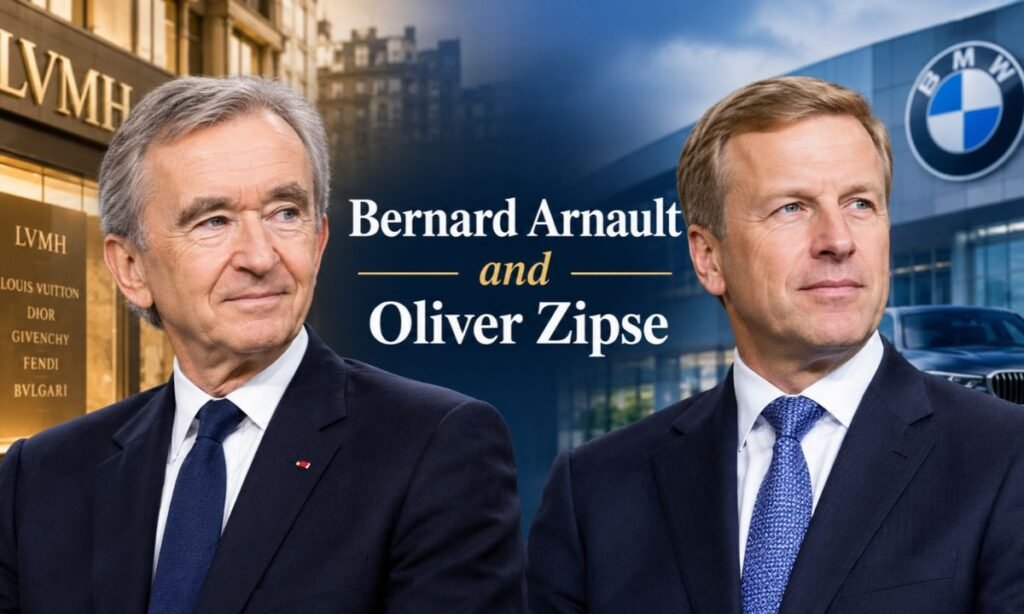
Why do people search Bernard Arnault and Oliver Zipse together? Good question. No reliable evidence shows they are relatives, colleagues, or partners. Yet the pairing makes sense. One man built a luxury empire through ownership. The other climbed a famous automaker from the bottom rung. That contrast drives this guide.
This guide covers Bernard Arnault and Oliver Zipse: connection, careers, wealth and leadership in plain English. You will see how LVMH and BMW Group shaped each leader. We compare pay, power, and corporate leadership styles. Along the way, American readers will spot familiar names like Tiffany & Co. and BMW’s Spartanburg plant. Ready to dive in? Let’s go.
Bernard Arnault and Oliver Zipse at a Glance
Think of this as your quick scoreboard. Bernard Arnault is a French billionaire born in 1949. Oliver Zipse is a German engineer born in 1964. Both reached the top of major European companies. Their routes could not look more different.
The table below shows the essentials. Read each row from left to right. Notice the gap in business ownership versus professional executive management. That single contrast explains almost everything else in this comparison. Small details matter here.
| Detail | Bernard Arnault | Oliver Zipse |
| Born | March 5, 1949 | February 1964 |
| Nationality | French | German |
| Industry | Luxury goods | Automotive |
| Company | LVMH | BMW Group |
| Route to the top | Investment and ownership | Internal promotion |
| Top role | Chairman and CEO since 1989 | BMW Chairman, 2019 to 2026 |
| Status | Chairman and CEO of LVMH | Airbus Non-Executive Director |
Read More: David Lawler and Bruce Broussard Careers, Leadership, and Achievements
What Is the Connection Between Bernard Arnault and Oliver Zipse?
The honest answer is simple. They connect through comparison, not through friendship or family. Records show no shared employer and no joint venture. Writers pair them because they show two ways to win in global business.
Could LVMH and BMW overlap somewhere? Sure. Both chase premium customers through design, events, and marketing. However, overlap is not partnership. No major alliance links the two companies. Think of two neighbors who never share a fence.
Who Is Bernard Arnault?
Bernard Arnault leads LVMH as Chairman and CEO. The group owns more than 75 brands. Born in Roubaix in 1949, he studied at École Polytechnique and trained as an engineer. Luxury came later in his story.
His path moved fast. He chaired the family firm Ferret-Savinel by 1978. In 1984 he took over Financière Agache and gained Christian Dior. LVMH formed in 1987. By 1989 he held majority control as Chairman and CEO.
Who Is Oliver Zipse?
Oliver Zipse is a German engineer born in Heidelberg in 1964. He studied computer science and mathematics at the University of Utah and mechanical engineering at the Technical University of Darmstadt. Later he finished an Executive MBA with the Kellogg School of Management.
He joined BMW in 1991 as a trainee. He climbed steadily for 35 years. Zipse became Chairman in August 2019 and left on May 13, 2026. Now he serves Airbus as a Non-Executive Director. That is quite a journey.
Bernard Arnault vs Oliver Zipse: Key Differences
The biggest gap is where authority comes from. Arnault mixes ownership with executive control. Zipse held power because BMW’s governance system appointed him. One man owns the house. The other ran it. Let’s break down five key areas.
Here is a quick snapshot of seven contrasts. Use it to see the full picture before we dig deeper into each point below. Every row reflects a real choice in career or company structure. Simple, right?
| Area | Arnault | Zipse |
| Leadership model | Owner and executive | Professional executive |
| Main industry | Luxury goods | Automotive |
| Route to the top | Investment and acquisitions | Internal promotion |
| Company relationship | Ownership plus management | Long-term employee |
| Governance | Strong family influence | Board-led structure |
| Core experience | Investment and luxury brands | Engineering and production |
| Top-role period | LVMH leader since 1989 | BMW Chairman, 2019 to 2026 |
Owner vs Professional Executive
Arnault acts like a landlord who also runs the building. His family owns a big stake in LVMH. Zipse acted more like a skilled property manager. He earned authority through experience and appointment. That difference shapes business ownership, risk, and reward for each leader.
Luxury Goods vs Automotive Industry
The luxury goods industry sells desire, craft, and scarcity. The automotive industry sells machines that must work every day. LVMH guards brand stories. BMW Group manages factories, software, batteries, and supply chains. Each business rewards different skills and different instincts.
Acquisitions vs Internal Career Growth
Deals built Arnault’s career. He used investment and acquisitions to gain control of famous names. Promotions built Zipse’s career. His internal career growth took decades inside BMW. One path buys opportunity. The other earns it through patience. Both approaches work.
Family Control vs Corporate Management
Family ownership gives the Arnault family long-term voting and economic power at LVMH. BMW works differently. Its Supervisory Board appoints and oversees the Board of Management. This corporate governance model explains how Zipse became Chairman and how Milan Nedeljković later succeeded him.
Decision-Making Authority
Arnault shapes investment, acquisitions, and senior hires across LVMH. His ownership backs those calls. Zipse also held real power. However, BMW’s boards set clear limits. Broad influence versus defined authority sums up the corporate leadership contrast. That is the heart of it.
How Their Career Paths Compare
Two men. Two roads. One shared destination at the top of global business. Arnault moved through engineering, investing, and ownership. Zipse moved through development, production, and planning. Each step built skills that matched the company ahead.
Picture a ladder and an elevator. Zipse climbed the ladder rung by rung inside one company. Arnault rode the elevator of capital and control. Both reached the penthouse. The ride felt very different. Let’s look closer at each journey.
Bernard Arnault’s Growth Through Investment and Acquisitions
After graduating, Arnault joined his family’s construction business. He then pursued business restructuring at Financière Agache and built around Christian Dior. As LVMH grew, it added Fendi, Bulgari, and Tiffany & Co. American shoppers know that last name very well.
Oliver Zipse’s Rise From Trainee to BMW Chairman
Zipse started in development and production. He worked in Germany and South Africa. In 2007 he ran the MINI plant in Oxford. A 2015 board seat followed with production duties. In August 2019 he became BMW Group Chairman. Few executives follow such a steady path.
Two Different Routes to Corporate Leadership
Arnault followed an owner-builder model. Zipse followed a career-executive model. The first needs capital, nerve, and patience. The second needs technical depth and trust from boards. Ask yourself which path fits your own goals better. Both demand years of focus.
Bernard Arnault and Oliver Zipse Leadership Styles
Arnault leads like a gardener of luxury houses. Each Maison keeps freedom in design, products, and image. LVMH then adds capital, distribution, and strategic support. That balance protects brand identity and exclusivity while the group keeps growing.
Zipse led like an engineer with a toolkit. He pushed flexible manufacturing so BMW plants could shift with demand. He also backed electric cars while keeping other drivetrain options. His long-term business strategy focused on adapting to markets moving at different speeds.
What Did Bernard Arnault Contribute to LVMH?
Arnault helped turn LVMH into the world’s largest luxury group. It now holds more than 75 brands. The company reported €80.8 billion revenue in 2025. That luxury brand portfolio has few rivals. Revenue alone tells only part of the story.
His real contribution is structure. LVMH blends big-group resources with Maison independence. That model lets Louis Vuitton, Moët Hennessy, and others stay distinct. Selective acquisitions added new categories without erasing heritage. Here are the main pillars.
- Fashion and leather goods
- Jewelry and watches
- Perfumes and cosmetics
- Wines and spirits
- Selective retail
What Did Oliver Zipse Contribute to BMW?
Zipse led BMW Group through a huge shift in cars. His electric vehicle transition plan blended battery work, software, and Neue Klasse. His manufacturing and production strategy stayed his strongest area. Flexible plants let BMW respond to uneven demand across regions.
The numbers back this up. BMW delivered 2,463,715 vehicles in 2025. Electrified deliveries reached 642,087, up 8.3%. Plans call for 40 new models and updates with Neue Klasse technology by 2027. Results will become clearer after his exit.
Bernard Arnault vs Oliver Zipse: Wealth and Financial Influence
Wealth comparisons need context. Arnault holds ownership. Zipse earned executive pay. Mixing those two models would be like comparing a landlord’s building to a manager’s salary. The Bernard Arnault Oliver Zipse net worth question has a clear but uneven answer.
Forbes estimated Arnault and family at about $137.1 billion on September 3, 2026. That figure moves daily with LVMH shares. No verified number exists for Zipse. Salary reports do not reveal private assets or debts. Treat exact online figures with caution.
Bernard Arnault’s Wealth and LVMH Ownership
Most of the estimated fortune comes from family ownership in LVMH through Groupe Arnault S.E. When the share price rises or falls, the estimate swings by billions. It is an estimate, not an audited account of cash or personal assets.
Oliver Zipse’s Earnings as a Corporate Executive
Zipse earned pay through BMW’s remuneration system. Executive compensation can include salary, performance bonuses, long-term incentives, and pension benefits. Yet pay is not net worth. His property, savings, investments, and debts are not public. No exact figure is truly reliable.
Ownership Wealth vs Executive Compensation
Owning a large stake in a major company can create far more wealth than any salary. The table below shows why the two models behave so differently as markets rise and fall over time. Compare the sources, risks, and visibility of each.
| Factor | Arnault | Zipse |
| Main source | Family ownership of LVMH | Executive pay and private assets |
| Share price effect | Moves estimate by billions | Mostly indirect |
| Public clarity | Forbes estimate available | No verified net worth |
Who Had Greater Financial Influence?
Arnault has far greater personal financial influence because of ownership. Zipse steered billions in vehicle development, factories, and technology as BMW chairman. However, controlling a budget differs from owning the company. Net worth and financial influence should never be confused with corporate spending power.
LVMH vs BMW: How Their Business Models Differ
Both sell premium products. Yet the economics differ sharply. LVMH manages a luxury brand portfolio built on craft, pricing, and selective distribution. BMW Group runs a global industrial network that demands heavy spending on engineering, factories, and batteries.
Growth also works differently. LVMH expands through acquisitions and brand building. BMW expands through product and production investment. Neue Klasse shows this well. It changes vehicles, batteries, software, design, and factories all at once. Each model shaped its leader’s role.
How Bernard Arnault and Oliver Zipse Approached Innovation
At LVMH, technology and innovation serve creativity. Teams use new tools in product development, customer service, and operations. The rule is simple. Technology must never dilute Louis Vuitton, Christian Dior, or any Maison’s identity. Heritage is the asset.
At BMW, innovation lives in the machine. Batteries, drivetrains, software, computing, and manufacturing methods all evolved under Zipse. Both companies face one question. How do you change without losing what customers love? Each answers it in its own way.
Their Impact on Their Industries
Arnault proved that one group can own many houses. Each house still keeps its own voice. LVMH now counts 75+ brands and over 6,280 stores worldwide. That scale reshaped the global market competition in luxury. That reach is hard to ignore.
Zipse left a different mark. He pushed BMW toward electric vehicles, batteries, software, and Neue Klasse. Arnault represents ownership influence in global luxury. Zipse represents professional executive influence in autos. Both shaped how big companies compete and grow.
Challenges and Major Business Decisions
Neither leader had an easy road. In 2025, LVMH revenue fell from €84.7 billion to €80.8 billion. Recurring operating profit slipped from about €19.6 billion to €17.8 billion. Arnault also must grow famous houses without hurting their exclusivity.
Zipse faced tariffs, weaker China sales, rising competition, and costly electrification. Still, BMW delivered about 2.46 million vehicles and earned above €10 billion in group earnings. American readers will notice the tariff angle. Trade rules can reshape car prices fast.
| Leader | Main Pressure | Response |
| Arnault | Softer luxury demand | Quality, creativity, long-term investment |
| Zipse | Tariffs, China, EV costs | Flexible production, technology choice, Neue Klasse |
What Can Business Leaders Learn From Bernard Arnault and Oliver Zipse?
Great lessons hide in both careers. Arnault teaches patience and brand discipline. Zipse teaches depth and adaptability. You do not need billions to borrow these ideas. A small business can use them tomorrow morning. Here is what stands out.
Which lessons matter most to you? Start with the lists below. Each one comes straight from how these leaders ran their companies. Pick one and test it this week. Small steps compound over time. Simple.
From Arnault:
- Protect brand identity.
- Think long term.
- Give teams independence.
- Invest in quality.
- Use acquisitions carefully.
From Zipse:
- Learn the business from inside.
- Build broad experience.
- Keep strategic options open.
Where Are Bernard Arnault and Oliver Zipse Now?
As of 2026, both men remain active. Arnault still leads LVMH as Chairman and CEO. Zipse has moved from running a carmaker to advising an aerospace giant. Their current roles reflect their different careers perfectly.
Here is a quick status check for 2026. It shows how ownership keeps one leader in place while board service defines the other’s next chapter. Titles matter less than the structures behind them. Keep that in mind.
| Leader | 2026 Role |
| Arnault | Chairman and CEO of LVMH |
| Zipse | Non-Executive Director at Airbus |
Bernard Arnault’s Current Role at LVMH
Arnault remains Chairman and CEO of LVMH. He also serves as President of the Board of Directors of Groupe Arnault S.E., the family holding company. This mix of executive power and family ownership keeps him closely tied to the group’s long-term direction.
Oliver Zipse After Leaving BMW
Zipse ended his 35-year BMW career on May 13, 2026. Milan Nedeljković became Chairman the next day. Airbus had already appointed Zipse on April 14, 2026. He serves as a Non-Executive Director and sits on the Audit Committee. That is oversight, not operations.
Frequently Asked Questions
Are Bernard Arnault and Oliver Zipse related?
No reliable evidence shows any family link. Arnault was born in Roubaix, France. Zipse was born in Heidelberg, Germany. Their documented family and career histories stay separate.
Did Bernard Arnault and Oliver Zipse ever work together?
No documented evidence shows direct work together. Arnault built his career around LVMH. Zipse spent his career at BMW from 1991 until 2026 before joining the Airbus board.
Does Oliver Zipse have any connection to LVMH?
No known connection exists. Zipse worked at BMW and now serves on the Airbus board. The two companies share premium customers but have no major alliance.
Who is richer, Bernard Arnault or Oliver Zipse?
Arnault is far richer. Forbes estimated his family’s wealth at about $137.1 billion on September 3, 2026. No verified net worth exists for Zipse, whose income came from executive compensation.
What companies does Bernard Arnault control?
Arnault leads LVMH as Chairman and CEO. He also presides over the board of Groupe Arnault S.E., the family holding company. LVMH owns more than 75 brands, including Fendi and Bulgari.
How are Bernard Arnault and Oliver Zipse’s leadership styles different?
Arnault protects brand identity and gives Maisons independence. Zipse focused on engineering, flexible production, and technology choice. Ownership shaped one style. Professional management shaped the other.
Final Thoughts
Bernard Arnault and Oliver Zipse share no personal link. Yet their comparison teaches plenty. One leader built control through ownership, acquisitions, and patient brand care. The other rose through BMW over 35 years of technical and management work.
Which path appeals to you? Perhaps both hold lessons for your own career. Check every figure before you rely on it. Wealth, titles, and sales numbers change fast. Keep learning from both leaders, and let their contrast sharpen your own goals.

Through poetry, Zain Seo gives words to feelings that are often difficult to express. As the author behind Poetry Linez, Zain Seo writes about love, heartbreak, life, emotions, hope, and the stories within every heart.
