
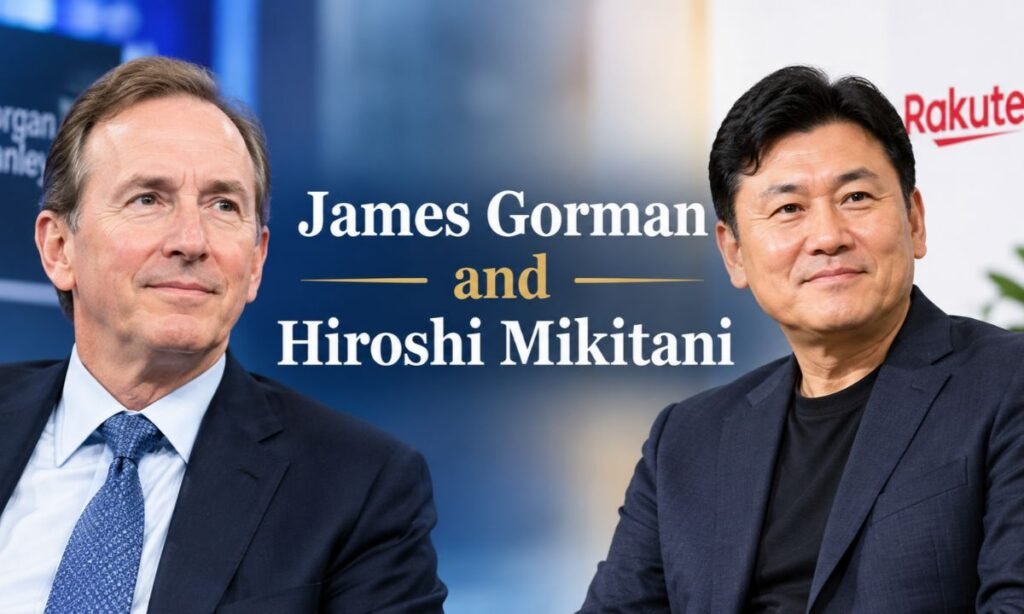
Two finance-trained leaders rebuilt giants across the Pacific. James Gorman and Hiroshi Mikitani lead very different companies today. One now chairs The Walt Disney Company. The other founded and still runs Rakuten. You might wonder why people search for them together. This guide explains the clear pattern behind both careers.
No public record shows a joint deal between them. Still, their careers run on parallel tracks. Gorman rebuilt Morgan Stanley around wealth. Mikitani turned a small online mall into a digital empire. Along the way, you’ll see risks, wins, and lessons. Read on to see which playbook fits your goals. Both stories offer practical ideas for modern leaders.
Two Very Different Starting Points
Great careers rarely begin on the same road. James Gorman and Hiroshi Mikitani prove that point well. One was born in Melbourne, Australia. The other was born in Kobe, Japan. That shared start shaped how they later ran giants.
Think of finance as a training ground. It teaches you to read risk fast. It also teaches patience with capital. Both finance-trained business leaders took those habits along. They shaped corporate leadership strategies for years. Their paths differ while the toolkit looks familiar.
James Gorman’s Path From Melbourne to Wall Street
Gorman studied arts and law at the University of Melbourne. Next, he earned an MBA at Columbia University. He began as a Melbourne lawyer. Later he became a senior partner at McKinsey. After that, he held several executive roles at Merrill Lynch.
Hiroshi Mikitani’s Path From Kobe to Founder
Mikitani studied at Hitotsubashi University before banking. He joined the Industrial Bank of Japan in 1988. He earned a Harvard Business School MBA during leave. Then the 1995 Kobe earthquake hit his hometown. That tragedy pushed him to start a business.
What Finance Training Gave Gorman and Mikitani
Finance taught both men to think in portfolios. It sharpened their sense of financial risk management. It also trained them to allocate capital with care. You can spot that habit in each big move. Numbers guided even their boldest bets.
| Factor | James Gorman | Hiroshi Mikitani |
| Birthplace | Melbourne | Kobe, 1965 |
| Education | Melbourne arts and law, Columbia MBA | Hitotsubashi, Harvard MBA |
| Early career | Lawyer, McKinsey, Merrill Lynch | Industrial Bank of Japan |
Read More: 220+ Friendship Shayari in English 2026
James Gorman: Rebuilding Morgan Stanley Around Wealth
Few leaders reshaped a bank like Gorman did. He joined Morgan Stanley in February 2006. His first job was running wealth management. He became CEO in January 2010. He became chairman in January 2012. He held the CEO job until December 2023.
His central bet sounded simple enough. He wanted less dependence on volatile trading revenue. That choice anchored his business transformation strategies. The wealth management business became the engine. It gave the firm steadier income across market cycles.
The Big Bet Against Volatile Trading Revenue
Trading revenue swings with every market mood. Wealth fees tend to move more slowly. Gorman leaned hard into that stability. He nudged the financial services industry toward steadier models. Wealth management revenue grew into a core pillar. Investors soon noticed the calmer earnings.
The Smith Barney Merger and the Acquisition Spree
The 2009 merger with Citi’s Smith Barney unit reshaped everything. By 2013, 16,000 advisors oversaw $1.8 trillion in assets. Then came corporate acquisitions and mergers in 2020. Morgan Stanley bought E*Trade and Eaton Vance. Eaton Vance cost $7 billion and added $500 billion.
Case Study: The Eaton Vance Deal
- Announced: October 2020
- Price: $7 billion
- Added: about $500 billion in assets under management
- Goal: steadier fee income
The Results Behind the Strategy
The numbers tell a clear story. Client assets hit $6.5 trillion in 2022. It passed $7.5 trillion in client assets by Q3 2024. Euromoney reported a 26% pre-tax margin for wealth in 2023. That margin signals strong company revenue and profitability.
Hiroshi Mikitani: From 13 Stores to a Digital Ecosystem
Big empires often start in tiny rooms. Mikitani and three co-founders put in $250,000. Their firm, MDM, Inc., launched in February 1997. Months later, the Rakuten Ichiba marketplace opened. You can call it humble beginnings.
Today that mall anchors a huge digital commerce ecosystem. Shopping feeds cards, banking, securities, and mobile. Each service brings customers to the next. That loop turned one site into a group. It also made Rakuten hard to copy.
Launching Rakuten Ichiba in 1997
The site opened on May 1, 1997. It started with 13 vendors and six team members. The company took the Rakuten name in 1999. It then went public in 2000. That climb built a major e-commerce marketplace. Humble roots carried very big promise.
The Merchant-First Model That Set Rakuten Apart
Rakuten let vendors build their own storefronts. Merchants also kept the customer relationship. Unlike Amazon, Rakuten chose a merchant-first model. This choice gave sellers real control. It also helped the platform grow through partnership. Merchant loyalty became a lasting advantage.
Global Expansion and the Costly Misses
Around 2010, Mikitani drove international business expansion. He bought Buy.com, PriceMinister, Kobo, and Viber. He also backed Pinterest and Lyft. Yet not every single bet paid off. The $300 million Lyft stake produced losses. He left Lyft’s board in 2020.
The Mobile Gamble
Mobile became his biggest and boldest gamble. Rakuten launched a $5.5 billion mobile service in 2020. This mobile network expansion demanded huge upfront spending. Still, big investors showed up in 2021. Tencent, Japan Post Holdings, and Walmart invested over $2 billion.
Case Study: Rakuten Mobile
- Launch: 2020, backed by a $5.5 billion service
- 2021 backers: Tencent, Japan Post Holdings, and Walmart
- Milestone: 10 million subscribers on December 25, 2025
- Open question: steady profit across the group
Two Playbooks, Compared
Compare the two playbooks and a clear split appears. Gorman improved an institution that already existed. Mikitani kept building brand new businesses. Both leaders used big capital moves often. Yet their daily work looked very different.
Think of it as steward versus founder. A steward guards and sharpens what already exists. A founder plants fresh seeds every year. Each role carries its own pressure. Smart business readers can borrow ideas from both.
The Steward vs. The Founder: Two Leaders Who Rebuilt Giant Companies
Gorman acted as a professional steward. He used acquisitions, cost discipline, and corporate succession planning. Mikitani worked as a serial founder. He built five businesses around one customer base. Each piece feeds all the others. That focus kept both men highly disciplined.
The Rakuten flywheel:
- Shopping
- Cards
- Banking
- Securities
- Mobile
Different Leaders, Different Risks
Gorman’s biggest risk sits in execution. Big deals must blend in smoothly. Mikitani faces a heavier financial risk. Rakuten lost roughly $1.1 billion in 2025. Revenue that year hit $16.1 billion. It marked a seventh straight year in the red.
Side-by-Side Comparison Table
This table sums up the contrast at a glance. Use it as a quick reference. Notice how strategy shapes each risk. A steward fixes and refines daily. A founder builds and absorbs shocks. Both paths demand a lot of nerve.
| Factor | James Gorman | Hiroshi Mikitani |
| Role | Steward and chairman | Founder and leader |
| Home company | Morgan Stanley | Rakuten |
| Core strategy | Shift toward wealth management | Expand a digital ecosystem |
| Growth method | Large acquisitions | Launches, acquisitions, alliances |
| Main risk | Execution and succession | Heavy financial strain |
| Key number | $7.5 trillion in client assets | 10 million mobile subscribers |
Where Each Stands in 2026
The story now moves to 2026. Gorman focuses on The Walt Disney Company. Mikitani focuses on turning mobile into profit. Both men face fresh and public tests. Each test will shape a legacy. You can watch both stories unfold in real time.
Timing matters a great deal in leadership stories. Gorman’s succession work at Disney peaked early this year. Mikitani’s mobile unit hit a long awaited milestone. Both results arrived within months of each other. This moment shows leadership and business innovation at work.
Gorman at Disney
Gorman became Disney’s chairman on January 2, 2025. He also led its succession committee. On February 3, 2026, Disney named Josh D’Amaro CEO. D’Amaro took over from Bob Iger on March 18. The board considered more than 100 candidates. Every board member approved the choice.
Mikitani and Rakuten Mobile’s Milestone
Rakuten Mobile passed 10 million subscribers on December 25, 2025. That mobile telecommunications business posted its first full-year EBITDA profit. Rakuten Bank reached 17.63 million accounts. Rakuten Securities passed 13.26 million accounts. These digital banking services now power the group.
The Japan Connection
A loose link ties these two worlds together. Morgan Stanley’s biggest Japanese partner is MUFG. In January 2026, executives sought deeper ties. Those ties span wealth, trading, and investment banking. That is a Morgan Stanley story. It does not involve any Rakuten deal.
What Business Readers Can Take Away
Strong stories end with practical lessons. Three clear ideas stand out here. You can apply each one at work. They fit big firms and small teams alike. Each lesson comes from real decisions. Let’s walk through them one by one.
Lessons matter most when you can act on them. Treat each one as a prompt for corporate growth strategies. Ask what applies to your own team. Then test it on a small scale. Keep what works and drop the rest.
Lesson One: Change Your Identity, Keep Your Core
Morgan Stanley shifted its weight toward wealth. Rakuten added mobile on top of commerce. Neither firm abandoned its core business. Both built on strengths they already owned. You can follow that same path. Start from what you already do best.
Lesson Two: Treat Succession as a Skill
Good succession deserves real, regular practice. Gorman ran the Morgan Stanley handover. Then he took charge of Disney’s. That record shows a pattern worth studying. Plan early and pick candidates with care. Give your board plenty of time to decide.
Lesson Three: Patience Costs Real Money
Mikitani’s mobile bet took years to show progress. Costs piled up long before results arrived. The full payoff still remains unproven. Patience in this case costs real money. Protect your cash runway at all times. Track each milestone with honest eyes.
Key takeaway: Reinvent your business while protecting the core that made it strong.
Frequently Asked Questions
Are James Gorman and Hiroshi Mikitani business partners?
No public record shows a joint deal. People link them because their careers run in parallel. Both men trained in finance first. Both also helped rebuild giant companies. Gorman worked through Morgan Stanley and Disney. Mikitani built his path through Rakuten.
What does James Gorman do now?
Gorman chairs The Walt Disney Company today. He took that role on January 2, 2025. He also chaired the succession committee. That group chose Josh D’Amaro as CEO. Earlier, he led Morgan Stanley’s customer asset management push. He ran that bank for nearly fourteen years.
How did Hiroshi Mikitani start Rakuten?
Mikitani founded MDM, Inc. on February 7, 1997. He and three co-founders put in $250,000. Rakuten Ichiba launched on May 1, 1997. It opened with 13 vendors and six staff. The name Rakuten arrived in 1999. The 1995 Kobe earthquake had inspired his move.
What turning points shaped each leader’s career?
Gorman moved from law to McKinsey, then Merrill Lynch. He joined Morgan Stanley in 2006. Mikitani left banking after the 1995 Kobe earthquake. That event pushed him toward entrepreneurship. Different turning points built very different companies. Each turn rewarded bold, informed choices.
Is Rakuten profitable?
Not yet at the group level. Rakuten reported a roughly $1.1 billion net loss for 2025. Revenue reached $16.1 billion that year. However, mobile posted its first full-year EBITDA profit. Rakuten also set a 29th straight year of record revenue.
Which leader’s strategy looks stronger?
Honestly, neither strategy wins outright yet. Gorman’s approach delivered steady growth in client assets. Mikitani’s approach built a wider ecosystem with higher risk. Your answer depends on your own goals. Watch Disney’s results and Rakuten’s mobile profits. Time will test both approaches fairly.
Final Thoughts
James Gorman and Hiroshi Mikitani prove finance training leads anywhere. Gorman played the role of steward. Mikitani played the role of founder. Both men truly rebuilt giant companies. Their paths show two roads to growth. Each road demands skill and nerve.
Watch two stories closely from here. First, see how Disney performs under D’Amaro. Second, see if Rakuten Mobile turns users into profit. Those answers will show whose strategy ages better. Share your view in the comments below. Then come back and compare notes.

Through poetry, Zain Seo gives words to feelings that are often difficult to express. As the author behind Poetry Linez, Zain Seo writes about love, heartbreak, life, emotions, hope, and the stories within every heart.
